AI agents are changing how solopreneurs operate. They handle complex workflows, talk to customers, and run multi-step processes without you watching over them. Unlike basic chatbots, these systems make decisions, learn from results, and juggle tasks.
The agent landscape in 2026 is noisy. Frameworks, models, and platforms are everywhere. This guide cuts through the noise to show what actually works for a one-person business.
What Makes AI Agents Different From Traditional Automation
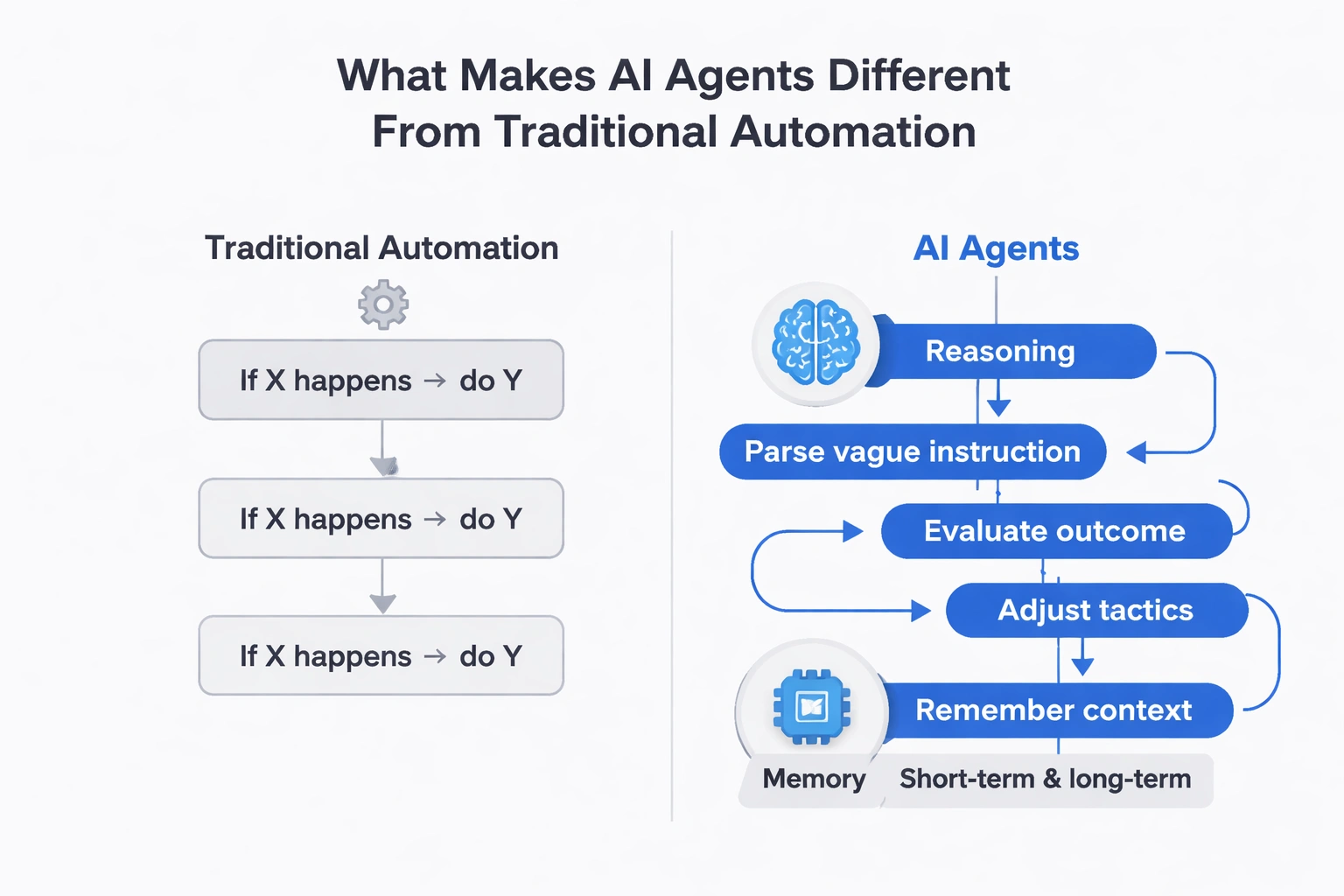
Old automation follows a script. If X happens, do Y. Agents don't need that script. They figure out the steps themselves. They parse vague instructions and handle exceptions without predefined rules. A bot follows logic; an agent negotiates a meeting time by understanding the context.
Reasoning is the main difference. Agents powered by models like GPT-4o or Llama 3.1 break down goals, evaluate what happened, and change tactics if needed. They also remember things.
Memory matters. Short-term memory keeps track of the conversation. Long-term memory stores user preferences and past decisions. This combination lets an agent give personalized service that improves over time.
Tool integration expands their reach. They connect to APIs and databases to get information and take action. An agent can research competitors, update your CRM, and draft emails from a single instruction.
Essential Use Cases for Solopreneur Businesses
Customer support automation is usually the highest-impact start. Agents handle 70-80% of common questions, passing complex issues to you with full context. They work 24/7 and don't get tired.
Content research and drafting speeds up marketing. Agents scan industry news and competitor content for ideas. They outline posts and draft content, letting you focus on strategy and editing rather than facing a blank page.
Lead qualification and outreach changes sales pipelines. Agents score inbound leads by analyzing behavior and data. They write personalized outreach, follow up with non-responders, and book meetings.
Administrative task management clears the backlog. Agents transcribe notes, process invoices, and send reminders. One solopreneur saved 12 hours a week just by offloading routine admin.
Social media management keeps your presence alive. Agents monitor mentions, suggest replies, and schedule posts based on when your audience engages.
Choosing the Right Agent Framework
LangChain is the standard here. It has the tool integration and community support. The learning curve is real, but the documentation is good.
AutoGPT-style autonomous agents are flexible for long, complex tasks. They run independently and self-correct. But they burn API credits and can drift off-task if you're not careful with prompts.
CrewAI frameworks let you build teams. One agent researches, one writes, one edits. This mirrors human workflows and often gets better results than a single agent.
Low-code platforms like Zapier Central and Make Agents are for non-technical founders. You trade some power for speed. You can build in hours instead of weeks.
Check the repos directory for open-source options like Hermes Agent or GPT Engineer before building from scratch.
Building Your Solopreneur AI Stack
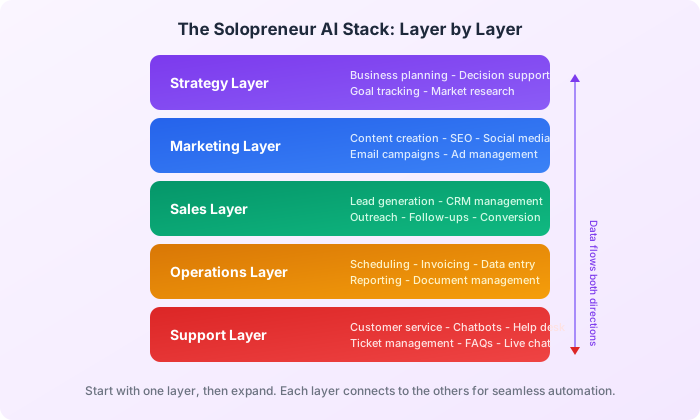
You don't need twenty tools. You need one per layer, and they have to talk to each other. This is the architecture that holds up in practice:
- Support layer ($0-$50/mo): customer service automation — Crisp on the free tier, or Intercom Fin
- Operations layer ($20-$50/mo): scheduling (Calendly) plus basic automation (Zapier free tier)
- Sales layer ($0-$60/mo): a lightweight AI CRM like Attio that auto-syncs from email, plus Clay for lead enrichment
- Marketing layer ($20-$100/mo): ChatGPT Plus or Claude Pro for content, Buffer for social scheduling, Canva for design
- Strategy layer ($20/mo): Perplexity for market research, Notion AI for SOPs and documentation
A minimum viable stack runs about $80/month. A full growth stack lands closer to $300/month — either is a rounding error against the $60,000+ salary equivalent of the team it replaces.
Selection rule: don't build the stack by features. Build it by bottleneck. Find your biggest time sink, solve that one with a single tool, measure it, then move to the next.
See how to build a one-person business with AI for the wider operating model, or the 27 AI tools ranked by what actually sticks for per-layer picks.
Implementation Strategy for First-Time Builders
Start with one thing. Pick a high-frequency task that eats time but follows a pattern. Email triage or scheduling. Don't try to automate your whole business at once.
Define boundaries. Be clear about what requires human approval. Most solopreneurs start with agents that draft responses but wait for approval to send.
Invest in prompt engineering. Your instructions determine most of the performance. Test prompts, document what works, and create templates. Good prompts matter more than the code around them.
Build monitoring from day one. Track completion rates, errors, and time saved. Log actions. If you can't see it, you can't fix it.
Your 7-Day Implementation Roadmap
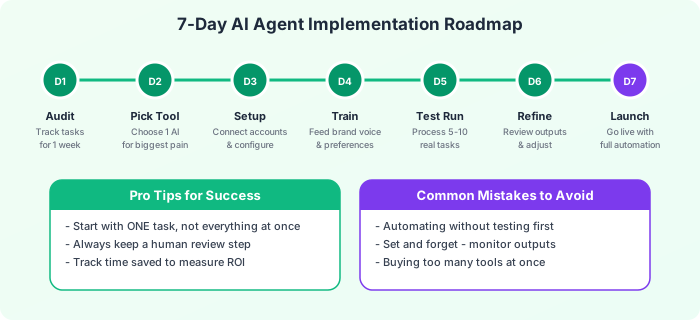
Going from zero to one working agent takes a week, not a quarter:
- Day 1 — Audit your time. Track every task for 24 hours. Sort each into creative/strategic, repetitive, or administrative. The last two categories are your targets.
- Day 2 — Pick one tool. One tool, for your biggest time sink. Don't optimize the choice; you're after a quick win, not a perfect setup.
- Day 3 — Connect and configure. Wire it to your email, calendar, site, and social accounts.
- Day 4 — Train it. Feed it context: past content, FAQ docs, email templates.
- Day 5 — Test run. Push 5-10 real tasks through it and write down what breaks.
- Day 6 — Refine. Tune prompts and templates. Expect 3-5 iterations before it's usable.
- Day 7 — Go live. Launch the workflow and set up monitoring the same day.
The mistake that kills this: deploying five tools at once. Solopreneurs who do that abandon all five inside a month. One layer at a time.
Cost Management and Model Selection
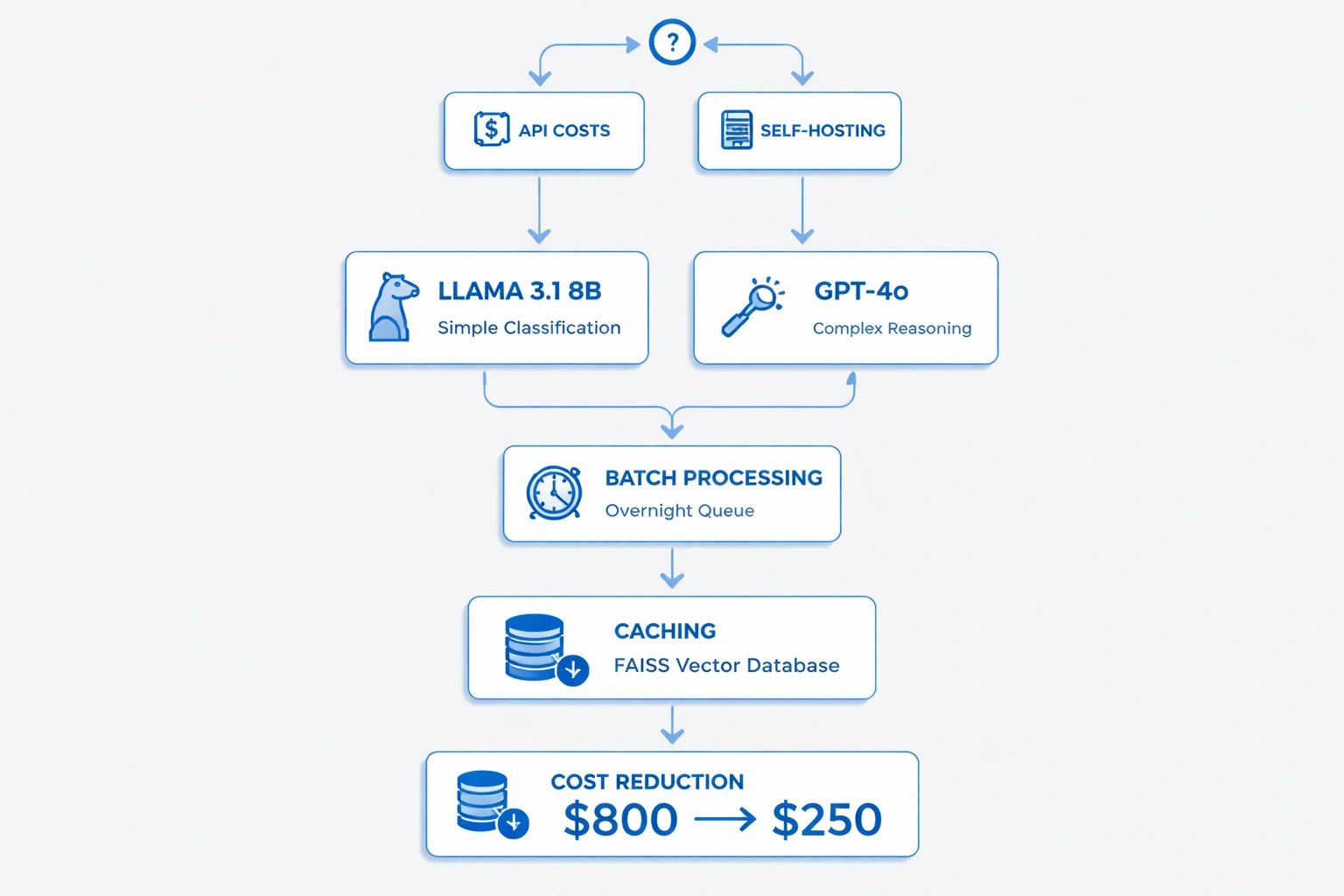
API costs add up fast. Self-hosting takes upfront work but eliminates per-use fees.
Match the model to the job. Use smaller models like Llama 3.1 8B for simple classification. Reserve GPT-4o for complex reasoning. This approach cuts costs 60-70%.
Batch processing saves money. Queue tasks like research or data analysis to run overnight.
Cache your data. Store frequently accessed info in vector databases like FAISS instead of re-querying. One agency cut monthly costs from $800 to $250 just by caching competitor research.
Security and Privacy Considerations
Don't send sensitive data to public APIs without consent. Use local models for regulated data.
Audit permissions. An agent connected to your email can read everything. Use least-privilege access.
Keep prompts in private repos. They are your IP.
Test in a sandbox. Don't let an agent accidentally email your entire list or delete production data.
Integration With Existing Tools
CRM connectivity turns agents into a necessity. They log calls and update stages automatically.
Calendar integration handles the scheduling back-and-forth.
GitHub Copilot shows how agents assist developers.
Pair Paperless-ngx with extraction agents to handle documents.
Training Agents on Your Business Context
Generic agents give generic results.
Build a knowledge base. Document your processes and brand voice.
Use few-shot learning. Give 3-5 examples of good output.
Rate the outputs. Create feedback loops to guide improvement.
Update context quarterly. Stale data makes agents drift.
Common Pitfalls and How to Avoid Them
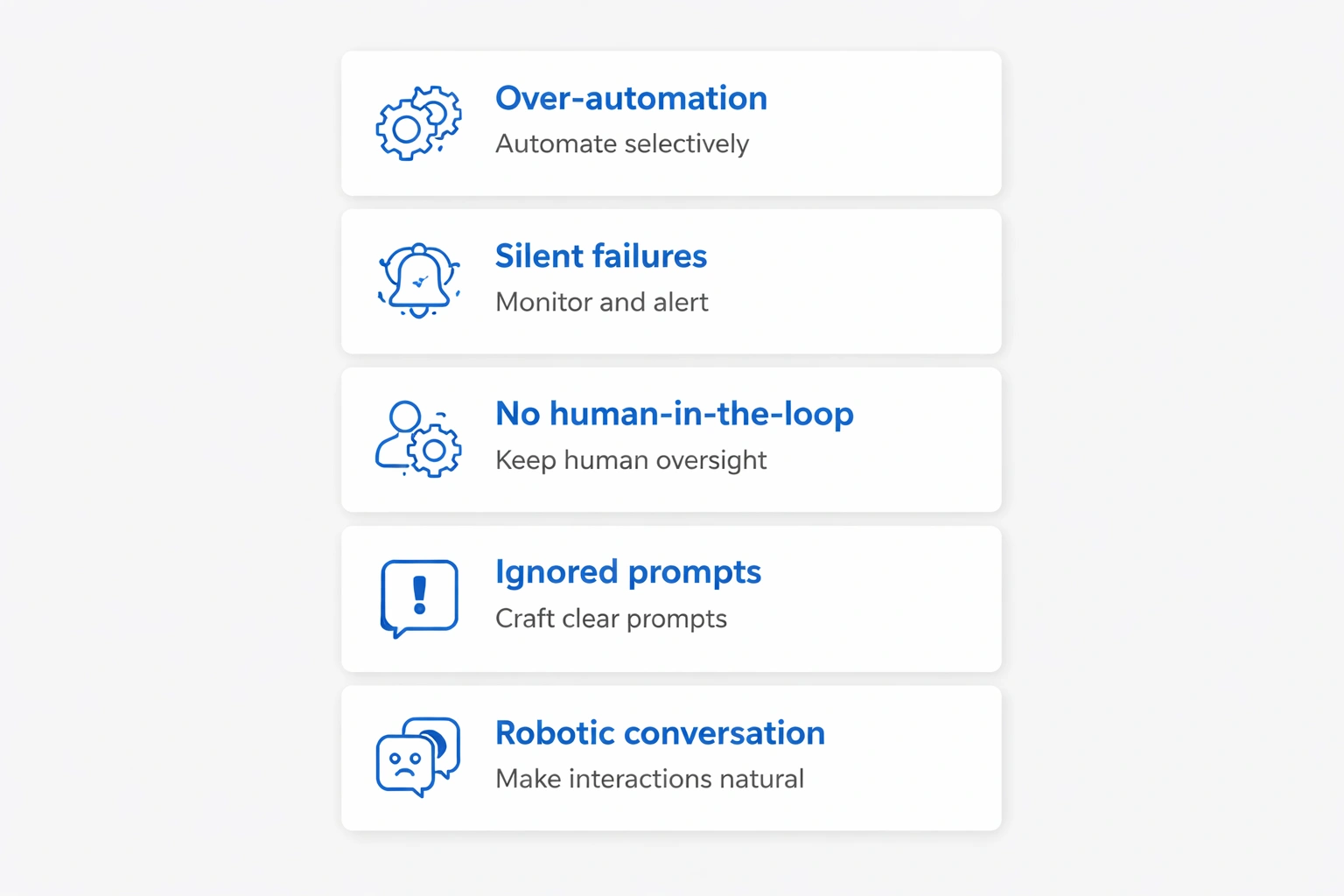
Over-automation early on. Automating everything creates a mess. Focus on one workflow.
Silent failures. Build alerts so you know when agents stop working.
No human-in-the-loop. Don't let agents sign contracts or handle complaints alone.
Ignored prompts. Review performance monthly.
Robotic conversation. Design interactions that sound natural.
Measuring ROI and Success Metrics
Time savings are the easiest metric. Hours saved times your hourly rate.
Quality checks. Does the output meet your standards?
Customer satisfaction. Does automation hurt the experience?
Cost per task. Total expense divided by tasks done.
Business impact. Did conversions or traffic improve?
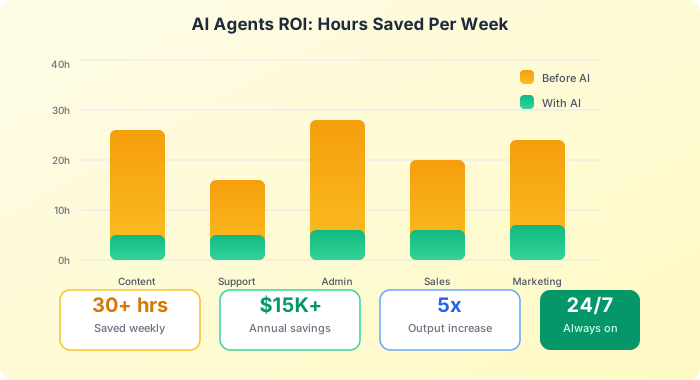
Here is the shape those savings usually take once agents cover the core workflows:
| Task Category | Before AI | With AI | Hours Saved |
|---|---|---|---|
| Content Creation | 15 hrs/week | 3 hrs/week | 12 hrs |
| Customer Support | 10 hrs/week | 2 hrs/week | 8 hrs |
| Admin & Operations | 12 hrs/week | 3 hrs/week | 9 hrs |
| Sales Outreach | 8 hrs/week | 2 hrs/week | 6 hrs |
| Total | 45 hrs/week | 10 hrs/week | 35 hrs |
At an effective rate of $75/hour, 30 hours a week back is roughly $117,000 in annual time value. Subscriptions run $1,200-$3,600/year against that. Handing the same 30 hours to contractors at $25/hour would cost about $39,000/year, and you'd still be managing them.
The Future of AI Agents for Solopreneurs
Specialization is next. Expect agents built for specific verticals like legal or e-commerce.
Multi-modal agents will handle text, audio, and video together.
Collaborative ecosystems will let agents from different vendors coordinate.
Privacy tech will open doors for healthcare and finance.
Check the tools directory and models collection for updates.
Getting Started Today
Audit your week. Find tasks that take more than 2 hours and repeat.
Try ChatGPT manually for your target task.
Join communities. Look at repos like Trading Agents and Career Ops for guides.
Use no-code if you need to. A simple agent shipped today beats a complex one you never finish.
AI agents are the best leverage available to solopreneurs right now. They let one person operate like a team.