

Open Source
LangChain
Agent engineering platform for building LLM applications from composable parts
No reviews yet

Vector database with hybrid search and modules—build smarter retrieval without stitching five services by hand.
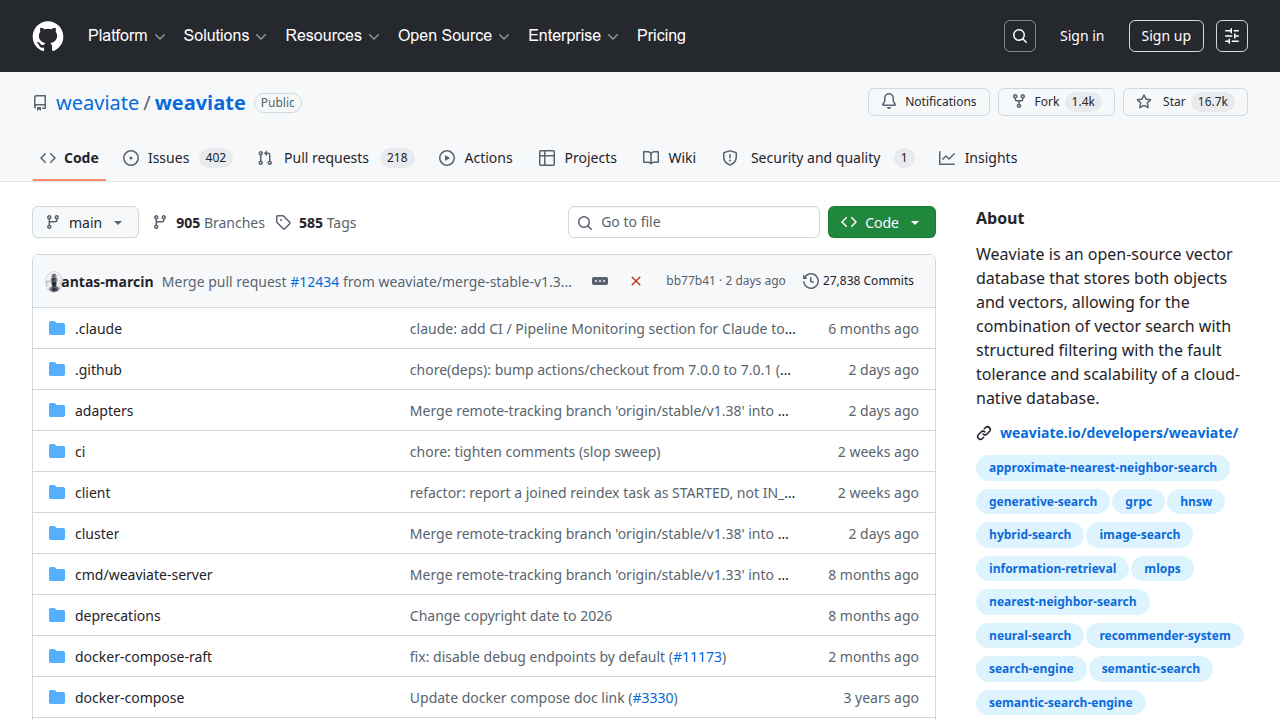
Weaviate is an open-source project solopreneurs use when they want leverage without locking every workflow into a closed SaaS. Vector database with hybrid search and modules—build smarter retrieval without stitching five services by hand. Weaviate is a vector database that emphasizes semantic search with optional modules for vectorization, hybrid retrieval, and generative patterns. Solopreneurs consider it when they want search infrastructure that can grow with features—keywords plus vectors—without assembling a fragile DIY stack.
Why solopreneurs use it
Users search like humans: sometimes keywords, sometimes vibes. Hybrid capabilities reduce “I know the doc exists but chat missed it” tickets that destroy indie NPS. Modular vectorization can simplify pipelines if you prefer the database to help with embeddings. The tradeoff is learning Weaviate’s data model, which pays off when search is core to the product rather than a checkbox.
What you can build
Documentation portals with AI answers, knowledge marketplaces, customer-facing semantic search, and RAG systems needing hybrid ranking. Media or commerce niches that rely primarily written in Go. Community signal on GitHub is strong (about 16,678 stars at last sync), which usually means docs, issues, and examples are easier to find when you get stuck. On SolopreneursHub we file it under Open Source so you can discover it next to related AI repos, AI tools, and AI models.
Weaviate fits solo founders, indie hackers, and small agencies who need a concrete capability—approximate-nearest-neighbor-search, generative-search, grpc, hnsw, hybrid-search, image-search—without hiring a platform team. If you are validating an AI-assisted product, packaging a niche assistant, or cutting SaaS spend while you grow MRR, this repo is worth a serious look. It is less ideal if you need a turnkey consumer app with SLAs on day one; in that case start with a hosted product from our tools directory and revisit Weaviate when margins or privacy requirements push you toward self-hosting.
Keep this Weaviate listing open next to our open-source category and the upstream GitHub repository for README details, license terms, and release notes.
Ship a private MVP without burning API credits. Weaviate helps you prototype the core loop locally or self-hosted so you learn what users want before you scale spend.
Productize a niche workflow. Wrap Weaviate behind a thin UI or API and sell a focused outcome (drafting, research, automation, or codegen) instead of a generic chatbot.
Client delivery accelerator. Agencies and freelancers use Weaviate to compress delivery time on demos, audits, and internal tools while keeping sensitive data off shared SaaS tenants.
Content and SEO operations. Pair Weaviate with your publishing stack to research outlines or draft faster—then edit hard so the result stays AdSense-safe and human.
Whatever use case you pick, define a success metric before you customize deeply—activation, time-to-first-value, or cost per successful run. That keeps Weaviate from becoming an endless tinkering project.
Documentation quality varies by module. Stick to the happy path first, then customize once metrics prove the feature matters.
For monetization ideas that sit on top of open-source building blocks, see how makers position paid products in our AI tools catalog and compare packaging patterns on alternatives pages.
When founders evaluate Weaviate, they usually also look at LangChain and ECC. Comparisons should be job-based, not star-count-based: what outcome are you selling, how hard is day-2 operations, and can you hire (or be) the maintainer of the glue code?
When you are ready to shortlist options side by side, open Weaviate alternatives and cross-check peers in the repos directory. If you are weighing a managed product instead, scan comparable listings under tools and productivity.
Also worth bookmarking: the SolopreneursHub home page for curated picks, categories for browsing by theme, and submit if you maintain a repo that should be listed.
If you get stuck choosing between adjacent projects, revisit the comparison section above and the live Weaviate alternatives list.
Usually open-source means you can experiment freely, but commercial packaging depends on the exact license and any model or dependency licenses you pull in. Read the repository license and third-party notices before you sell access.
Self-host when privacy, margin, or customization matter more than convenience. Choose SaaS when your bottleneck is distribution and support, not infra. Many founders prototype with Weaviate, then offer a hosted tier once demand is clear—browse both repos and tools while you decide.
When founders evaluate Weaviate, they usually also look at LangChain and ECC. Rank options by time-to-demo, ops complexity, and license—not hype. Our Weaviate alternatives page keeps that shortlist updated.
Yes. Typical stacks mix Weaviate with models from AI models, orchestration or UI layers from AI tools, and adjacent OSS from repos. Start from Open Source if you want thematically related picks.
Read this listing, check Weaviate alternatives, then explore featured tools you might wrap commercially. When your own product is ready, submit a listing so other solopreneurs can find it.
Agent engineering platform for building LLM applications from composable parts

Agent harness optimisation for Claude Code, Codex, OpenCode and Cursor

Self-improving agent from Nous Research that learns across sessions

Small, composable agent skills from Matt Pocock's daily .agents directory