

Open Source
Dify
Low-code LLMOps platform to design, run, and observe AI apps—ship assistants faster than custom chrome allows.
No reviews yet

Open-source IDE autopilot—bring AI coding into VS Code or JetBrains without surrendering your codebase to a black box.
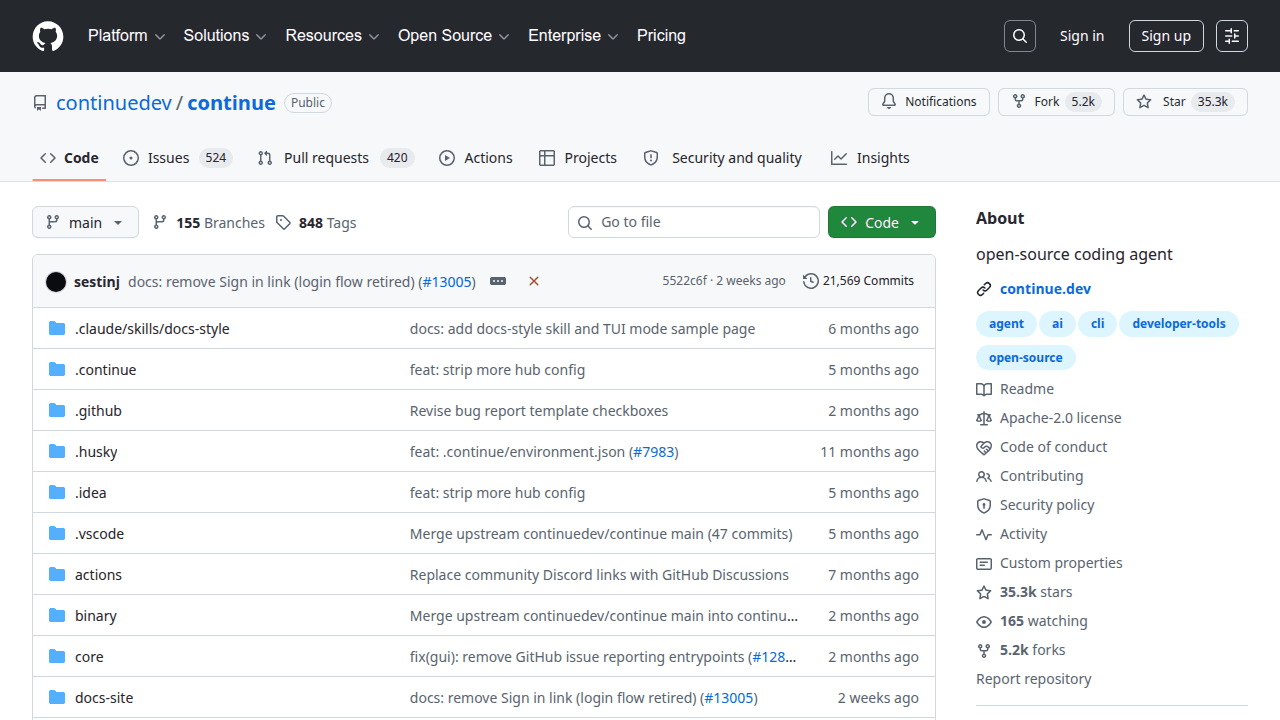
Continue is an open-source project solopreneurs use when they want leverage without locking every workflow into a closed SaaS. Open-source IDE autopilot—bring AI coding into VS Code or JetBrains without surrendering your codebase to a black box. Continue is an open-source AI coding assistant that integrates into popular IDEs, supporting customizable providers and workflows. Indie developers adopt it to get inline help and chat over the repo while retaining control of models and prompts.
Why solopreneurs use it
Closed assistants are fine until privacy, cost, or customization blocks you. Continue lets you point at local models or your preferred APIs and tune behavior for your stack. That flexibility matters when you build in regulated niches or want the same assistant across machines. Staying in the IDE preserves flow state better than browser chat.
What you can build
Daily coding copilots, team-shared assistant configs, and local-model setups for offline or sensitive repos. Educators distribute Continue configs for coursework environments.
Getting started tip
Connect one provider, index a medium repo, and create a custom sl. As with most OSS, validate maintenance activity on recent commits and issues before you bet a production roadmap on it. On SolopreneursHub we file it under Code & Development so you can discover it next to related AI repos, AI tools, and AI models.
Continue fits solo founders, indie hackers, and small agencies who need a concrete capability—ide, coding-assistant, oss, vscode—without hiring a platform team. If you are validating an AI-assisted product, packaging a niche assistant, or cutting SaaS spend while you grow MRR, this repo is worth a serious look. It is less ideal if you need a turnkey consumer app with SLAs on day one; in that case start with a hosted product from our tools directory and revisit Continue when margins or privacy requirements push you toward self-hosting.
Keep this Continue listing open next to our open-source category and the upstream GitHub repository for README details, license terms, and release notes.
Replace a paid SaaS seat. If a vendor charges per seat for something Continue already covers well enough, OSS can drop COGS while you stay flexible.
Build an agent or RAG feature. Continue often becomes a building block inside a larger solopreneur product: retrieval, tools, memory, or orchestration.
Automate repetitive operator work. Solo founders wire Continue into cron jobs, webhooks, or flows from our AI tools catalog so nights and weekends are not spent on copy-paste ops.
Educate and convert. Tutorials and teardown posts around Continue attract builders who later become customers of your paid wrapper or services.
Whatever use case you pick, define a success metric before you customize deeply—activation, time-to-first-value, or cost per successful run. That keeps Continue from becoming an endless tinkering project.
Expect a steeper first week than clicking “Sign up” on a SaaS. The payoff is margin and flexibility once the workflow is stable.
For monetization ideas that sit on top of open-source building blocks, see how makers position paid products in our AI tools catalog and compare packaging patterns on alternatives pages.
When founders evaluate Continue, they usually also look at Dify and Flowise. Comparisons should be job-based, not star-count-based: what outcome are you selling, how hard is day-2 operations, and can you hire (or be) the maintainer of the glue code?
When you are ready to shortlist options side by side, open Continue alternatives and cross-check peers in the repos directory. If you are weighing a managed product instead, scan comparable listings under tools and productivity.
Also worth bookmarking: the SolopreneursHub home page for curated picks, categories for browsing by theme, and submit if you maintain a repo that should be listed.
If you get stuck choosing between adjacent projects, revisit the comparison section above and the live Continue alternatives list.
Usually open-source means you can experiment freely, but commercial packaging depends on the exact license and any model or dependency licenses you pull in. Read the repository license and third-party notices before you sell access.
Self-host when privacy, margin, or customization matter more than convenience. Choose SaaS when your bottleneck is distribution and support, not infra. Many founders prototype with Continue, then offer a hosted tier once demand is clear—browse both repos and tools while you decide.
When founders evaluate Continue, they usually also look at Dify and Flowise. Rank options by time-to-demo, ops complexity, and license—not hype. Our Continue alternatives page keeps that shortlist updated.
Yes. Typical stacks mix Continue with models from AI models, orchestration or UI layers from AI tools, and adjacent OSS from repos. Start from Code & Development if you want thematically related picks.
Read this listing, check Continue alternatives, then explore featured tools you might wrap commercially. When your own product is ready, submit a listing so other solopreneurs can find it.
Low-code LLMOps platform to design, run, and observe AI apps—ship assistants faster than custom chrome allows.

Drag-and-drop LLM flows on LangChain concepts—prototype agent logic visually before committing to hard-coded graphs.

CLI pair programmer that edits your repo—ship features faster when you are the only engineer on the project.

Open autonomous software engineer agents that can navigate repos—delegate well-scoped coding tasks carefully.